
Reviews
The Stondon Singers are well regarded in the local press. Here are some recent reviews…
Christmas at Blackmore
Blackmore Priory
20.12.16
The passing of another year is marked by this annual Christmas treat; as so often, the last of the carol concerts in the calendar.
The Singers, conducted by Christopher Tinker, began with the fifteenth century simplicity of Busnois' Noel, Noel, Noel, written when the Augustinian priory here was at its most prosperous, and ended with an equally simple, equally moving My Lord Has Come, written in 2010 by Durham composer Will Todd.
Loyset Pieton, of whom little is known, worked in Dijon at the start of his sixteenth century career; his O Beata Infantia was a wonderful discovery. Other highlights of a varied programme were Alan Bullard's Shepherds, Guarding Your Flocks, premièred here a year ago, Malcolm Archer's A Little Child There Is Yborn, with its haunting Alleluias, a nimble arrangement by Mark Wilberg of Ding Dong Merrily, and the sweet harmonies of Gabriel Jackson's lilting Christ-child. Michael Frith was the accompanist at the organ.
The capacity crowd got a chance to sing, too, and after a rousing O Come All Ye Faithful, the Stondon's traditional Christmas encore, an a cappella Silent Night from the west end of the nave.
As Nick Alston pointed out in his introduction, a choir is not just for Christmas, and the Stondon Singers' busy diary for 2017 includes a Marian anthology in Queen of Heaven, Evensong in St Paul's Cathedral, and the eagerly awaited William Byrd Anniversary in Stondon Massey.
Byrd and the European Fringe
The Stondon Singers at Stondon Massey
05.07.16
William Byrd's celebratory Haec Dies was the curtain raiser to this anniversary concert, a fascinating collection of works, sacred and profane, by his contemporaries in Renaissance Europe.
Freedom of movement seems to have been no problem – Franco-Flemish or Scandinavian musicians migrating to find work in Italy or Spain, for instance. Such as Mogens Pederson, a Dane who met Gabrieli in Venice; we heard three of his delightful Italian madrigals.
Two settings of Vox in Rama: chromatic from Giaches de Wert, working in Spain, and exquisitely expressive from Polish composer Mikolaj Zielinski – fine singing from the Stondons under Christopher Tinker's direction. They also excelled in Byrd's Ave Verum of 1605, and in the nicely rounded sound of O Vos Omnes by one Robert Ramsey, who may have moved south from his native, independent Scotland in the retinue of his monarch in 1603.
A bonus on this glorious evening in Byrd's local church – lute music from Mike Ashley, with Annabel Malton soprano, including two contrasting pieces from another persistent Papist, master of melancholia John Dowland.
Christmas at Blackmore
Blackmore Priory
22.12.15
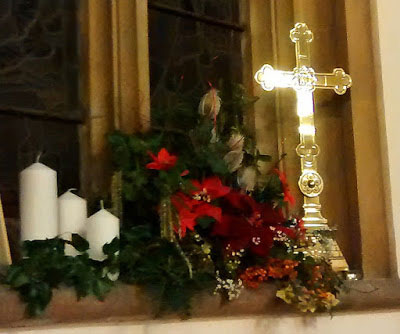 Full house this year for the Stondon Singers' traditional concert of carols and Christmas music. As usual, a bracing mix of old and new, the familiar and the discoveries, conducted and introduced by Christopher Tinker.
New to me was Jacob Handl, 16th century Slovene, whose Mirabile Mysterium was a challenging combination of the archaic and the modern. The evening ended with a favourite of mine since school days, Peter Cornelius's The Three Kings, sung from the west end of this ancient church.
A première: Alan Bullard's attractive setting of Shepherds Guarding Your Flocks, followed by Berlioz' Shepherds' Farewell. Two twentieth century pieces, beautiful in their simplicity, Rutter's Candlelit Carol and Britten's Hymn To The Virgin, with English and Latin alternating antiphonally.
Mark Ellis was the soloist in Vaughan Williams' Fantasia on Christmas Carols, splendidly performed, with Michael Frith at the organ. It concludes with an old version of a well-known carol from Somerset – let the last verse stand as season's greetings to you all:
God bless the ruler of this house,
And long on may he reign,
Many happy Christmases
He live to see again! God bless our generation,
Who live both far and near,
And we wish them a happy, a happy New Year.
Michael Gray
FAURÉ REQUIEM & CHICHESTER PSALMS
The Stondon Singers at Blackmore
14.11.15
Two great works from the choral repertoire, poles apart in many ways, but sharing a romantic solo at their heart. First, Bernstein's Chichester Psalms. The accompaniment, from the organ of Michael Frith and the harp of Gwenllian Llyr, was vibrant and muscular, and seemed to inspire the choir to up their game, too, producing a refreshingly assertive, open sound. Alto soloist Oliver El-Holiby, singing without a score, gave a wonderful account of the psalm, powerful but tender, with subtle dynamics, the choir softly shading in behind.
Oliver also gave us an aria from Gluck's Orfeo, and Hurford's beautiful setting of Herrick's Litany.
The Singers, directed by Christopher Tinker, ended the first half with early Whitacre: Waternight, an uplifting, intricately woven sequence of dissonances and tone clusters, well sustained by the choir.
The final work, Fauré's movingly simple Requiem, first given in the Madeleine in Paris with rather larger, and all-male, forces, was here underpinned by organ, with the harp for the Sanctus and the choir of angels. Hosannas, and Dies Irae, made a particular impact. Mark Ellis sang the baritone part from the ranks; the treble for the Pie Jesu was a confident and pure-toned Elliott Harding-Smith.
Michael Gray
William Byrd Anniversary Concert
Stondon Massey
7.7.2015
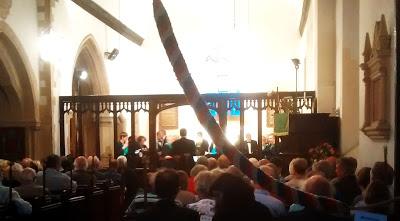 Imogen Holst's lovely Mass setting of 1927, rarely heard since she composed it while still a student, was the centrepiece of this year's Byrd concert. Performed with immaculate styling by the Stondons under Christopher Tinker – the graphic setting of “Jesu Christe” in the Gloria and the final “pacem” of the Agnus Dei were beautifully realised – it betrays the influence of her teachers Howells, Dyson and especially Vaughan Williams, as well as the Renaissance masters whose work made up the programme.
Tallis – an assured O Sacrum Convivium – and of course William Byrd, his heartfelt setting of Savonarola's Infelix Ego, dramatically progressing from a tentative “non audeo” to the climactic redemptive “misericordiam”. Plus four motets from the second book of Gradualia, dedicated to his fellow Catholic the First Baron Petre and described in the dedication as “blooms collected in your own garden”. And to end, a light-footed Madrigal, Though Amaryllis Dance in Green.
Always a pleasure to celebrate Byrd in the church by his Stondon Massey house; to sit in the nave he seldom frequented, to listen to a selection of his life's work, and to drink wine in the churchyard where he was “grudgingly” interred in 1623 and still lies in the tranquillity of an unmarked grave.
Michael Gray
Christmas at Blackmore
The Stondon Singers at the Priory Church
16.12.2014
 A delicate Christmas pot-pourri from this exceptional chamber choir, directed by Christopher Tinker.
The centrepiece was In Terra Pax, in which Gerald Finzi encases words from Matthew's Gospel in a poem by Robert Bridges, placing the Bible story in an English countryside setting. Beautifully sung here, with the significant solos – the Poet and the Angel - impressively handled by Mark Ellis and Michelle Arthur. And Michael Frith at the organ valiantly deputizing for the orchestra.
A similar theme in Peter Warlock's Bethlehem Down, which, like Jesus Christ The Apple Tree, featured exquisitely modulated pianissimo passages.
Tinker's own setting of I Saw A Maiden was tenderly phrased, and the folk-inspired Scots Nativity by Colchester composer Alan Bullard had a movingly eloquent simplicity.
There was a new Holly and the Ivy from Matthew Owens, and a different In Dulci Jubilo, "a multi-layered cake", with a high soprano line the frosting on top.
We had several chances to raise our voices, from Advent hymn to Adeste Fideles, and the evening was bookended by Es Ist Ein Ros' – first in the Praetorius original, then in a magical, mystical arrangement by Jan Sandstrom, its beautifully sustained notes floating up to the ancient rafters.
Michael Gray
For the Fallen
Stondon Singers at St Lawrence, Blackmore
11.11.2014
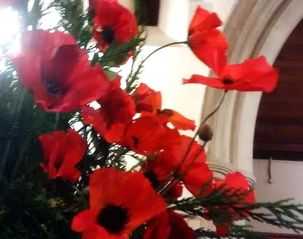 Armistice Day was marked in Blackmore with this timely concert, including works from some of the best-loved choral composers now writing.
But the evening began, and ended, with Douglas Guest's In Memoriam, a short, simple setting of Binyon's familiar words of remembrance; a reading too of a poem by Julian Grenfell, who lost his life in France in 1915.
Morten Lauridsen, master of American mysticism, wrote his Lux Aeterna after the death of his mother. It is a simple, heartfelt continuum of sacred texts on the theme of light, sung with sustained emotional momentum by the Singers under Christopher Tinker, with Michael Frith at the organ.
Even better suited to their forces was Rutter's Requiem, which was accompanied by members of the Meridian Sinfonia: the oboe for The Lord's My Shepherd, with its exquisite soprano solo, and the mournful cello for Out of the Deep, which seemed somehow to resonate with the ancient stones of this historic Priory church.
A memorable, moving musical commemoration of those lost in war, and proof that the Stondon Singers' expertise extends far beyond the Renaissance polyphony for which they are best known.
The fighting man shall from the sun
Take warmth, and life from the glowing earth;
Speed with the light-foot winds to run,
And with the trees a newer birth;
And find, when fighting shall be done,
Great rest, and fullness after dearth.
Michael Gray
War and Peace
The Stondon Singers at Ingatestone Hall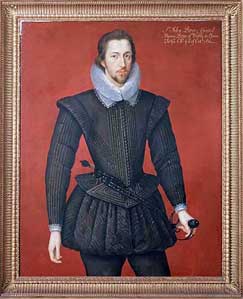
08.07.14
William Byrd was a frequent visitor to Ingatestone Hall, and to his patron the first Baron Petre. More than four hundred years on, he'd be slightly surprised, perhaps, to find the Hall still here, and lived in, and the eighteenth Baron in the audience for this concert.
War, the theme of Brentwood Arts Festival, is also still with us, of course, and Byrd's Civitas Sancti Tui, graphically depicting the desolation of Jerusalem, reminds us that nothing much has changed since the time of Isaiah.
A very different take on the battlefield in La Guerre, a highly coloured description of a French victory [in Italy, in 1515] by Jannequin, jingoistic avant la lettre, performed with relish by the Stondon Singers under Christopher Tinker.
Their a cappella polyphony sounded especially delightful in the panelled hall. Their themed programme, which also included Tallis, Victoria and two guys named Lobo, ended with an optimistic lollipop, one of Byrd's few secular works, the madrigal This Sweet Merry Month of May.
Michael Gray
Faire is the Heaven
Brentwood Cathedral
22.03.2014
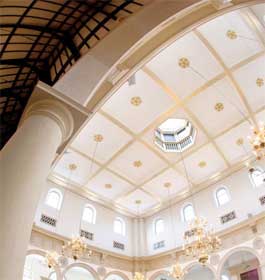 Forsaking the familiar Blackmore Priory for the resonant box of Brentwood Cathedral, the Stondon Singers, directed by Christopher Tinker, presented an impressive programme of English Church music. Beginning and ending with two majestic Handel coronation anthems – the substantial The King Shall Rejoice, and to start proceedings the ever-popular Zadok The Priest.
There was much intriguing cross-referencing: Parry's equally popular I Was Glad [glorious organ accompaniment from Stephen King] was contrasted with Purcell's more poignant setting, with the vocal parts blending beautifully in this acoustic. “Pray for the Peace of Jerusalem” was also heard in Herbert Howells' wartime setting. And Purcell's contemplative Hear My Prayer was set against Mendelssohn's Victorian version of the supplication, with Annabel Malton's pure soprano ringing thrillingly around the architecture.
E W Naylor's dramatic motet Vox Dicentis Clama, from 1911, was sung with admirable precision, the various voices clear and distinct
The concert took its title from W H Harris's Spenser setting, written in 1925. It was good to hear the works presented uninterrupted, though we did miss the scholarly introductions, especially as there was little help in the programme.
The Stondon Singers are back on their home ground [St Peter and St Paul Stondon Massey] on July 1, for the annual William Byrd anniversary concert.
Michael Gray
Watercolours
Stondon Singers at Blackmore Priory Church
12.11.2013
Music inspired by the natural world made for a pleasing programme from the Stondon Singers, conducted by Christopher Tinker. Lively choruses from Haydn's Creation, linked by readings and including a robust Heavens Are Telling and a precisely delivered Achieved is the Glorious Work, provided a contrast with the pastel, pastoral tone of many of these settings. As did the playful Ballad of Green Broom, the last of Britten's Five Flower Songs. Among the most enjoyable offerings were Elgar's gentle Torrents in Summer, William Hawley's evocative setting of Emily Dickinson's My River Runs to Thee, and the closing number, Stanford's much-loved Blue Bird, with Annabel Malton's pure soprano soaring above the nave. This is a chamber choir, and they excel in the delicate madrigals, like Wilbye's miniature Flora Gave Me Fairest Flowers. But they also rose to the challenge of the Haydn, Tinker's own Memento Mori, and Eric Whitacre's unaccompanied Water Night, with its intense, richly textured harmonies. Michael Frith, the Singers' accompanist, contributed a fine Bach Prelude and Fugue on the venerable St Laurence organ.
Byrd Anniversary Concert
Stondon Massey Church
02.07.2013
This year’s concert took place on July 2 at the usual venue, the Church of SS Peter and Paul in Stondon Massey, Essex, the village where Byrd lived for the final 28 years of his life. Also usual were the performers, The Stondon Singers; the friendly atmosphere; and the full house. For this year’s theme, Christopher Tinker, the choir’s conductor, chose Byrd and Alfonso Ferrabosco the elder. The two men were contemporaries and were on friendly terms, according to Byrd’s pupil Morley. Over the last half century, the researches of Joseph Kerman and others following him have revealed that in some of his earlier compositions, Byrd was indebted to Ferrabosco for cutting edge Continental ideas in structure and technique. We heard evidence of these in the two opening items, Byrd’s Emendemus in melius and Laudibus in sanctis. Underlining the musical engagement of the two men, sometimes the work of one was misattributed to the other. Scholarly opinion and musical evidence suggest that Byrd composed O praise our Lord, a sacred song in both five parts and five sections, and the secular song also in five parts Mount, Hope, above the skies. Both have alternative attributions to Ferrabosco in contemporary sources. Meanwhile Ferrabosco’s madrigal Se pur e ver picked up a misattribution to Byrd as the contrafactum Penelope ever was praised. All three of these were programmed. The two men also set the same text occasionally, so we were also treated to paired performances of Susanna fair and The nightingale. At Christopher’s request I gave a talk entitled "Five minutes on Ferrabosco and Byrd" midway through the first half of the concert. This part of the proceedings featured a complete performance of Sheppard’s Western Wind Mass. At a similar point during the second half, while Byrd and Ferrabosco held sway, Greg Camburn played half a dozen tunes by O’Carolan on the penny whistle. The concert ended with the diverting Italian salad by the nineteenth-century Prussian composer Richard Genee.
The choir has this music in its DNA and gave committed and thoughtful performances, led by Christopher Tinker’s clear, judicious and perceptive conducting. Sheppard’s mass in particular received a pensive, almost introspective, interpretation which was all the more welcome for shedding a different light upon this often exuberant composer. Christopher’s choice of programme was ideal: not only did he combine serious and lighter music successfully, but also he selected two pieces by Byrd that even I had never heard before, and I get to hear few personal Byrd premieres these days. In my hearing a distinguished academic visiting from Australia not only commented favourably on the choir, but also on how wonderful it was that a concert in a relatively remote rural location, offering such a programme, could fill the venue. The Stondon Singers, Christopher Tinker, and the composers deserved nothing less.
Richard Turbet - Published in Early Music Review, August 2013
This year's concert featured an early Tudor mass setting by Byrd's teacher John Sheppard – the Western Wind, based on a popular song, whose choral textures are often distilled to solo voices, for example in the Crucifixus and the Benedictus. Sung with lucidity and precision by the Stondons, conducted by Christopher Tinker. Just as enjoyable was the lollipop which closed the evening: Richard Genée's Insalata Italiana, an amusing parody of opera, using the gamut of Italian score markings, from piano to piu mosso, fronted by the impressive bass of Mark Ellis.
But the main theme of the programme was the influence on Byrd of another foreigner, the madrigalist and secret agent Alfonso Ferrabosco. So, helped by a brief talk by Richard Turbet, we could play compare and contrast, and spot the difference, for example with two very different settings of Susanna Fair, and two strikingly similar songs called The Nightingale.
And to end the first half, a collector's item, long misattributed, O Praise Our Lord. A lively piece, which, like the opening Laudibus in Sanctis, enumerates the instruments of praise, like "the gladsome sound of silver bells", before sinking back into a restful Amen.
As is traditional, we take refreshment amongst the gravestones. Somewhere in this remote churchyard William Byrd is buried, and may feel the footfall of those faithful few who still value his music and his witness.
Michael Gray
Choral Masterpieces from Venice
The Priory Church of St Laurence, Blackmore
9.03.2013
A very good audience turned out on a bitter evening to hear the Singers in an attractive programme of Choral Masterpieces from Venice. They were not disappointed. The choir was focused and responsive to their conductor Christopher Tinker, projecting a very good sound. They were aided by singing from the west end of the nave with a solid wall behind them. This provided a noticeably better acoustic than when they sing in the chancel. The choir also benefited greatly from singing with the accomplished musicians of The Meridian Sinfonia. Monteverdi’s psalm setting ‘Beatus Vir’ was given a sparkling performance with the solo passages ably taken by members of the choir. A Messa Concertanta by Francesco Cavalli is an inherently less taut work, in which the Gloria and Credo, although well sung, seemed to go on for quite a long time. The following Sanctus, Benedictus and Agnus Dei were more effective. After the interval, the sparkle most certainly returned with joyous singing to match joyous music in Vivaldi’s Gloria. The solo and duet items were performed by two promising young singers, Catriona Arthur and Chloë Treharne. Audience and performers alike clearly enjoyed themselves.
David Pears
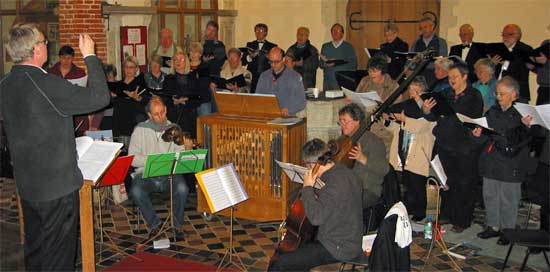
The Stondon Singers and The Meridian Sinfonia in rehearsal
Christmas at Blackmore
18.12.2012
History and tradition were respected at St Laurence this year: ending with Stille Nacht to send us off into the night, and beginning with Gaudete, Ben Parry's arrangement of an ancient tune which may well have echoed round these walls when the great Priory still dominated the village.
But there was a healthy injection of new music, too. Conductor Christopher Tinker led us through Matthew Owens' very different setting of The Holly and the Ivy, Thomas Hewitt Jones' What Child Is This, with its haunting motif [Michael Frith at the organ], Will Todd's My Lord Has Come, and Bob Chilcott's lively Sussex Carol arrangement, rhythmic and harmonically interesting, the tune often in the lower voices. All performed with care and commitment, the voices of this chamber choir blending effectively in these lovely surroundings.
The reading this year, by Mavis Holmes, was Kipling's Eddi's Service [where the congregation – "such as cared to attend" – were the Ox and the Ass] looking back to an early Christmas at St Wilfrid's in remotest Sussex, a church even older than Blackmore's ancient Priory.
Note-able Anniversaries Concert
27.10.2012
The Stondon Singers concert titled Noteable Anniversaries once more delighted the audience with some lovely rich sounds, impressive choral effects and a wide ranging programme.
The concert started with the rousing Laudate Dominum by Sweelink (born 1652), contrasted with the perhaps more familiar and gentle Dixit Maria by Hassler (died 1612).
These were followed by the Kyrie and Gloria of The Edinburgh Mass by Gabriel Jackson (born 1962), a modern composer who changes moods and keys in a most random but effective style. The singers coped admirably with this challenge!
Guest Musician of the concert was Evelyn Tinker (the surname is no coincidence) who played Bach Trio Sonata BWV 528 (and in the second half Bach Chorale prelude In Dir Ist Freude Bwv 615) in a most accomplished manner as might be expected, reading her biography in the programme. The audience certainly applauded with enthusiasm and she made the organ at Blackmore really speak forth and sound more than the sum of its parts.
Gabrieli’s (died 1612) Jubilate Deo was performed and the singers ably demonstrated the canonic style and choral textures in this exciting composition.
The Sanctus and Agnus Dei concluded the Edinburgh Mass setting and again was managed well by the singers, with solos by some members. The resolution of the Agnus Dei was a joy to hear.
The singers moved to the back of the church to complete the first half with the beautiful Inviolata by Willaert (died 1562). It a sublime composition - a wash of peaceful sound, sung very sensitively by the choir.
After an interval featuring decorated birthday cakes (a clever reference to the concert title) Gabrieli’s Kyrie was performed with one choir part taken by the organ and the rest of the singers towards the back of the church. It gave an effect of spaciousness, enhanced by the acoustics of the building and provided a grand effect.
Komm, Jesu, komm! by J S Bach was perhaps the longest item in the programme, but it was well sung and greatly enjoyed by the audience. This celebrated 800 years of the Choral Foundation at Leipzig.
John Ireland (died 1962) wrote his church anthem Greater Love in 1912. Often performed in church and cathedral alike, the choir did it justice. The chromatic treble solo was well-controlled and the overall performance well-rounded.
Following the second organ interlude, the singers performed Debussy (born 1862) Three Songs of Charles d’Orleans. Full of contrast, the second provided an opportunity for an accomplished alto soloist from within the choir.
The concert concluded with the contrasting O Peaceful Night by Edward German (born 1862). This varied concert programme all fell well within the scope of the singers, ably directed by Christopher Tinker; it was enjoyable, well performed and deserving of a bigger audience.
Sally Walker
William Byrd Anniversary Concert
03.07.2012
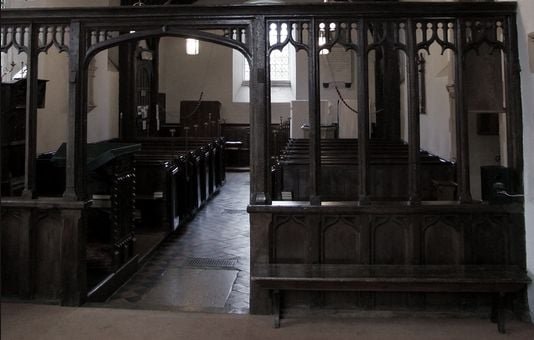
This little church has seen countless changes in nine centuries, many of them in the lifetime of William Byrd, who lived close by for the latter part of his life, but rarely ventured inside. Under the patronage of Lord Petre, this Catholic composer managed to survive the Reformation and happily composed both masses and Anglican anthems.
We heard both in this concert. The imitative polyphony of the Mass for Five Voices, the lower parts adding body and warmth to the sound, and O Lord Make Your Servant Elizabeth, written for the Virgin Queen. There was music from the "lost generation", between Tallis and Byrd, including a simple anthem by William Mundy; its Amen delivered with affecting simplicity.
After the interval - rum punch in the churchyard - a much wider range of music: Henry VIII's greatest hit, with tambourine obbligato from the Singers' conductor, Christopher Tinker, and the very different sound worlds of Italiam madrigals and five colourful, energetic songs by Kodaly.
A typically impressive evening of choral music from the Stondon Singers, with two bonuses: an organ Pavan by Byrd [Tinker again] on the charmingly voiced instrument, and a delightful extract from Henry Reed's Streets of Pompeii, first heard on radio sixty years ago.
Michael Gray
Touches of Sweet Harmony
21.04.2012
Shakespeare's getting an extra boost from the Games this year, and for his birthday, the Stondon Singers presented a garland of song settings and sonnets, based around Vaughan Williams's Serenade to Music.
This much-loved tribute to Henry Wood was given here in a choral arrangement, though we did hear brief solos from within the choir, and Michael Frith's organ accompaniment was remarkably effective.
The Singers' conductor, Christopher Tinker, contributed three songs written especially for this occasion, including a witty but demanding "Sigh no more", a plaintive "summer's lease" and a haunting recollection of "wild thyme" to end. Other groups of three from Essex composer Armstrong Gibbs and Vaughan Williams again, the choir showing their mettle in his Three Shakespeare Songs, written as a test piece for a national competition.
This very enjoyable concert began with Purcell's Faerie Queen, and ended with George Shearing's delicious jazz settings, including the familiar Lover and His Lass from As You Like It.
We also heard spoken sonnets - three from the Bard, and one from our Poet Laureate: Anne Hathaway's thoughts on that second-best bed:
"The bed we loved in was a spinning world of forests, castles, torchlight, clifftops, seas where we would dive for pearls. My lover's words were shooting stars which fell to earth as kisses on these lips; my body now a softer rhyme to his, now echo, assonance; his touch a verb dancing in the centre of a noun. Some nights, I dreamed he'd written me, the bed a page beneath his writer's hands. Romance and drama played by touch, by scent, by taste. In the other bed, the best, our guests dozed on, dribbling their prose. My living, laughing love - I hold him in the casket of my widow's head as he held me upon that next best bed."
Michael Gray
Christmas at Blackmore
20.12.11
Today the Christ is born - Hodie Christus Natus Est - bracketed this Yuletide concert, in two very different settings: the late Renaissance richness of Sweelinck and the devoutly lyrical Poulenc.
Between these two, we heard Britten and Part [the end of his Magnificat finely judged], two lively pieces by Imogen Holst, and a seasonal selection from Handel's Messiah: "For Unto Us" particularly successful in this chamber version.
The centrepiece was the glorious polyphony of Thomas Tallis - Videte Miraculum. From the 20th century two new favourites: Rutter's What Sweeter Music, and Kenneth Leighton's gentle lullaby, with a beautiful soprano solo.
Michael Frith was the organist, Christopher Tinker the conductor, and we also heard a reading of Clive Sansom's moving poem The Innkeeper's Wife: "The world is a sad place, But wine and music blunt the truth of it."
Before the mulled wine and mince pies, their traditional Silent Night, sung at the back of the Priory Church, to send us out inspired into the dark lanes of Jericho.
Michael Gray
An Old Belief at St Laurence, Blackmore
22.10.11
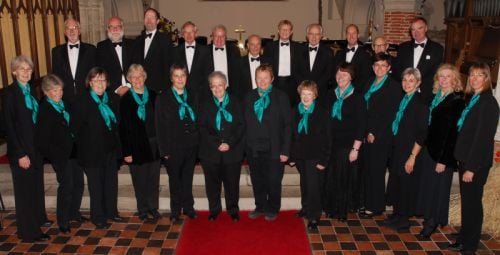
From the Fifteenth Century to A Child of Our Time, the Stondon Singers guided us through some of the finest sacred choral music.
The austere, rhythmically intricate Dufay, the richer sounds of Gabrieli, the eloquent harmonies of Lassus, the sublime cadences of Lotti's Crucifixus, traced the development of music to the Renaissance and beyond.
The Gabrieli was accompanied by Brentwood Brass – the final Alleluia of O Magnum Mysterium was especially effective – and they also gave us some purely instrumental interludes, including William Byrd's March for the Earl of Oxford, as well as Handel and Eleanor Rigby.
The Singers, directed by Chrisopher Tinker, jumped forward after the interval to Parry, the Songs of Farewell, including the meditation on death which gave the evening its title, two Elgar Part Songs, and finally the five Tippett Spirituals, featuring some superb step-out soloists from the choir.
I felt that the singers were perhaps more comfortable, more relaxed in the familiar harmonies of the twentieth century, but the structure of the programme gave us a valuable insight into the development of the sounds which have echoed through places of worship over six centuries.
There is an old belief
That on some solemn shore,
Beyond the sphere of grief,
Dear friends shall meet once more.
Beyond the sphere of Time and Sin,
and Fate’s control,
Serene in changeless prime
of body and of soul.
That creed I fain would keep,
That hope I’ll ne’er forgo:
Eternal be the sleep
If not to waken so.
Anniversary Concert at Stondon Massey
05.07.11
To Stondon Massey, for the annual concert commemorating the life and music of William Byrd. The Stondon Singers, under the exacting direction of Christopher Tinker, first gave us a suitably upbeat Sing Joyfully with a nice echo effect for “blow the trumpet”; Byrd’s contribution also included three Alleluias, and, from his secular pen, This Sweet and Merry Month, and a lively dance for Amaryllis which bounced beautifully along to follow the interval Pimms and pretzels.
There was Tallis, Sheppard and Stravinsky, and a second Sacrum Convivium from the modern British composer Gabriel Jackson – beautifully crafted in a sumptuous style with more than a hint of Whitacre and the French Romantics.
Tomas Luis de Victoria was featured too, in a performance of a mass from 1592 notable for the richly woven colours of the Kyrie. Victoria shares his 400th birthday this year with the King James Bible, and that work was celebrated with an impressive new piece from Michael Aves. “A Vision of the Word” was a challenge which the choir met with their customary diligence and enthusiasm; the harmonies of “Alpha and Omega” and the closing exhortation to “Write!” especially thrilling.
The concert ended with two helpings of Imogen Holst – The Twelve Kindly Months, and a dramatic arrangement of Gypsy Davy.
Michael Gray
FAURE REQUIEM AND THE ROMANTIC TRADITION
05.03.11
Christopher Tinker and his admirable singers, with Michael Frith at organ and piano, brought us familiar Fauré and a supporting programme of works from all corners of the Romantic legacy.
The Requiem began with an effectively deliberate Introit, and ended with the exquisite In Paradisum, beautifully sung by the sopranos and altos. The tenors and basses sometimes seemed underpowered for this repertoire, but the climaxes for the whole choir were often impressive - “Exaudi!” for example, or the robust Hosannas. I also admired the transition from the Agnus Dei to the Lux Aeterna. The Pie Jesu was sung, as Fauré intended, by a treble: Brendan Chung of the Brentwood Cathedral choir. A nicely controlled solo, his delivery of “sempiternam” making the prospect of life eternal very seductive.
Brendan also contributed briefly to the challenging Finzi in the first half. We heard four exquisite Bruckner motets: the Locus Iste from the west end, with a beautifully sustained ending. The Singers surrounded us on three sides for the Ave Maria – an interesting, if unbalanced, experience, exposing some individual voices. There was also a charming Berger Alleluia, and, new to me, American composer William Hawley's eight-part unaccompanied My River Runs To Thee, a tender, magical setting of Emily Dickinson, proving that Romantic music is still alive and well – Hawley is younger than most of us in the appreciative audience at the Priory Church.
Michael Gray
WILLIAM BYRD MEMORIAL CONCERT
06.07.10
For their annual homage to William Byrd, in his own parish church, the Stondon Singers chose three of his sacred works, including a lustrous, polished Plorans Ploravit, and three muscular madrigals.
The instrumental group Burntwood Musique – who turned out to be a recorder consort – chose dances that Byrd wrote for his friend and fellow Catholic, William Petre, his Pavan and Galliard. These lively pieces punctuated the main work of the evening, Monteverdi's Missa in Illo Tempore, complete with its substantial Credo. It began with a bright, positive Kyrie, and included a beautifully textured Benedictus.
The sound was glorious, a balanced, harmonious whole. Though I did wonder how his music would have sounded four hundred years ago within these same walls ...
The Stondon Singers, directed by Christopher Tinker, ended with more recent music: James McMillan, and the American William Hawley, whose simple Reverie 'My River Runs to Thee' – setting words by Emily Dickinson – was a hugely effective choice for this tranquil rural setting. Then El Grillo by Josquin des Prez, and a more contemporary Spanish text, the Argentinian Tango El Ultimo Café.
Michael Gray
MONTEVERDI VESPERS
St Thomas's Church Brentwood
17.04.10
After a day of unbroken sunshine and soundless skies, it was a particular joy to hear Monteverdi's great work in the Victorian splendour of the Church of St Thomas of Canterbury.
Christopher Tinker's interpretation was authentic, to the extent that anyone can know the composer's intentions. The spaces of the Nave, the Choir and the Transept were used to dramatic effect, for instance in the Audi Coelum, with its clever echoes.
The work consists of a string of varied psalms and sacred songs. The Laetatus Sum, with its intricate solo lines, was given lively rhythms, the equally exuberant Lauda Ierusalem, busy but crisply enunciated, ended with a superb Gloria, and the more literal Duo Seraphim, beginning with two voices, incorporated a third in a striking evocation of the Trinity.
The soloists generally, including two choir members, were key to the success of this ambitious venture; the Stondon Singers, as ever, were meticulously prepared and impressively fluent.
The intensity built inexorably towards the end, with the concluding Magnificat leading triumphantly to one last glorious Amen.
The impressive instrumental forces of the period instrument ensemble – scurrying strings and racing brass – created a bright exciting sound, helping to bring a flavour of Renaissance Venice to this corner of mid Essex.
Michael Gray
CONTRASTS
The Priory Church Blackmore
17.10.09
Two Requiems were at the heart of the contrasts, presented by the Stondon Singers under Christopher Tinker.
First, the richly textured Requiem Mass for Six Voices of Tomas Luis de Victoria, written four hundred years ago in the Golden Age of Polyphony. The Singers began behind us, at the West End; the voices were blended and balanced perfectly for this evocative acoustic – the Sanctus and the Agnus Dei seemed to grow organically from a single stem. The mass was followed by two extracts from the same composer's Office of the Dead, ending with the substantial Libera Me. A superbly moving sequence – it deserved a much larger audience.
Herbert Howells' Requiem, composed in 1954, and given its amateur première by this very choir, includes only two settings from the traditional mass, amongst Psalms and a final word from Revelation: I heard a voice from heaven saying … blessed are the dead which die in the Lord, for they rest from their labours. The Singers' performance of this challenging work was notable for some fine solo work, subtle harmonies and the calm resolution of the close.
After these two sombre works, the last contrast was provided by Britten's Choral Dances from Gloriana – a peal of bells for Time, serenity for Concord, and a lively Homage to the Old Queen to finish.
Michael Gray